
From 215 MLAs to 20: Can Mamata rebuild her political empire?
Exactly a month ago, Mamata Banerjee remained the undisputed face of the TMC, commanding a formidable legislative force.
PTI
-
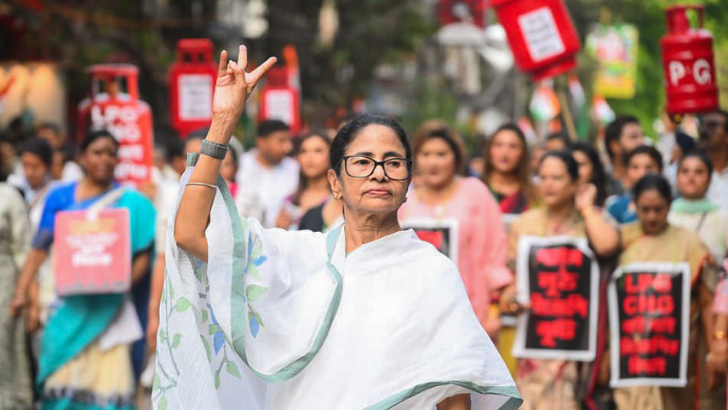
What appeared to be a devastating electoral defeat has now become an existential crisis for Mamata's TMC, founded in 1998 (ANI)
Kolkata, 4 June
For a politician who built her career on defiance,
resilience and an instinctive understanding of Bengal's political pulse, the
past month -- the one that marks the aftermath of the West Bengal Assembly
election results -- has been nothing short of a political earthquake for Mamata
Banerjee.
Exactly a month ago, Banerjee remained the undisputed face of the Trinamool Congress, commanding a formidable legislative force. But the
party's crushing electoral defeat at the hands of the BJP dramatically altered
the political landscape.
The setback was made more personal by her own loss from
Bhabanipur to her archrival and, as most would like to qualify, her nemesis --
Suvendu Adhikari -- from a constituency long regarded as her political
fortress. The poll results shrank the TMC's strength in the Assembly to 80
MLAs, leaving Banerjee to lead the opposition from a position of unprecedented
weakness. The party had 215 MLAs in the 2021 state polls.
Yet, what appeared to be a devastating electoral defeat has
rapidly evolved into an existential crisis for the party she founded in 1998.
On Wednesday, a group of dissident TMC legislators submitted
letters of support from 58 MLAs to Assembly Speaker Rathindra Bose, backing
expelled leader Ritabrata Banerjee as the leader of their legislature party and
staking claim to the position of Leader of the Opposition. Ritabrata claimed
that the rebel faction had two more MLAs as backup.
The move, which received the Speaker's subsequent sanction,
effectively signalled that more than two-thirds of the party's legislators had
drifted away from Banerjee's authority inside the Bengal Assembly.
The symbolism could hardly be starker. Only days earlier,
the TMC had expelled Ritabrata Banerjee and fellow MLA Sandipan Saha for
alleged anti-party activities, accusing them of undermining the organisation. Instead
of extinguishing the rebellion, the expulsions appear to have accelerated it.
TMC’s meteoric rise
The TMC's journey in the Bengal Assembly has mirrored its
meteoric rise until its recent decline.
Riding a historic anti-Left wave, the party secured 184
seats in 2011 and, along with allies, ended the Left Front's 34-year rule. It
consolidated its dominance with 211 seats in 2016 before reaching its zenith in
2021, winning 215 of the Assembly's 294 seats under Banerjee's leadership. Political
observers note that Banerjee now confronts a challenge unlike any she has faced
in nearly three decades of public life.
She has survived electoral setbacks, central investigations,
organisational revolts and ideological battles. But this crisis strikes at the
very heart of her authority: control over the party apparatus and legislative
wing.
"There was little surprise involved in the
disintegration of the party once it suffered electoral defeat. That's because
the party's primary objective -- to remove the Left Front from state power --
was met once it won the 2011 polls," said Shubhomoy Maitra, political
analyst. "It had no ideological fulcrum or, for that matter, a long-term
development vision for the state. There was nothing left for its MLAs to hold
on to, except personal interests," he said.
In an apparent attempt to regain control, the TMC dissolvedseveral key organisational committees and frontal wings, a move widely
interpreted as a last-ditch effort to prevent a formal split. Banerjee herself
has accused the BJP of using "money, arrests and threats" to engineer
a split in her party.
Speaking at a recent protest, she alleged that a concerted
campaign was underway to fracture the TMC and weaken opposition politics in
Bengal.
The BJP, meanwhile, has little incentive to immediately
absorb the dissidents. Several analysts point to the Maharashtra precedent,
where a breakaway faction was encouraged to emerge as a separate political
force rather than being directly merged into the ruling party. The growing
references in Bengal to an "Eknath Shinde model" reflect concerns
that the state's politics may be entering a similar phase of realignment.
"Despite Mamata Banerjee's amazing public life, one
cannot ignore the fact that she is past 70. At this age, a turnaround with the
same vigour she moved around with during the last four decades seems difficult.
Unless, of course, a politically improbable situation crops up that could
script her comeback," Maitra said.
Yet, writing Banerjee's political obituary would be
premature.
Few leaders in contemporary Indian politics possess her
capacity for political reinvention. She rose from the margins to dislodge the
34-year-old Left Front government, survived repeated predictions of decline and
transformed a regional movement into one of India's most influential opposition
parties.
Even now, the dissident camp has carefully continued to
acknowledge her as party chairperson, suggesting that the revolt is directed
more against the existing leadership structure and not so much against Banerjee
herself.
Senior TMC leader Saugata Roy said there's a strong chance
that Banerjee would tide past the current crisis, given her track record as a
fighter. "Such periods of crisis are temporary in a political life. Only a
decade ago, the BJP had just three seats in the assembly. Look where they are
now," he said.
"Even this won't last forever. Mamata needs to wait
this out. These so-called rebel MLAs will also return to the party fold sooner,
rather than later," the veteran leader said.
Asked, in the wake of the MLA mutiny against Abhishe kBanerjee, whether Mamata Banerjee has reached a juncture where she needs to
choose between the party and her nephew, Roy dismissed the conjecture as
"superficial".
"There's no need for a knee-jerk reaction to a political
problem such as this. Let's see how she handles this," he said.
Yet, observers believe that the central question is whether
Banerjee can once again convert adversity into opportunity. If she succeeds in
portraying herself as a victim of political engineering, she may yet retain her
stature among the party's grassroots workers. If she fails, the crisis could
mark the beginning of the most dramatic unravelling of a political empire
Bengal has witnessed since the decline of the Left Front.
Share Now

Leave a Reply
Your email address will not be published. Required fields are marked *
Other Stories
.png)

.png)

.png)
.png)
.png)